
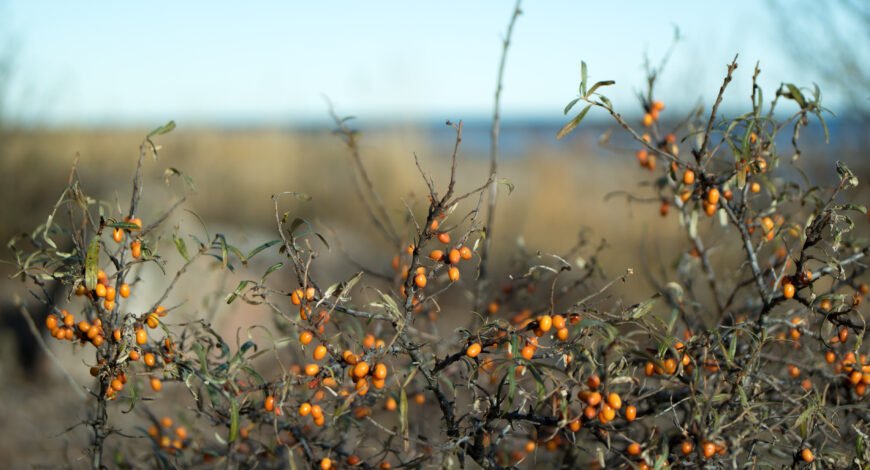
Sea buckthorn (Hippophae rhamnoides) is a thorny shrub that thrives where little else will — the cold, high valleys of the Karakoram and Himalaya. Its small orange berries are among the most nutrient-dense fruits studied, prized for an unusually high vitamin C content, a rare omega-7 fatty acid, and a deep store of antioxidants. Here is a clear, evidence-based look at what sea buckthorn contains, how those nutrients are traditionally used, and practical ways to add the berry, oil, and powder to your routine.
- Sea buckthorn berries are exceptionally rich in vitamin C — typically several times that of oranges.
- The pulp oil is one of the few plant sources of omega-7 (palmitoleic acid).
- It carries a broad mix of antioxidants — carotenoids, vitamin E, and flavonoids.
- Traditionally used to support skin and digestion; the science is promising and still developing.
- Easy to use as dried berries, oil, powder, puree, or jam.
What is sea buckthorn?
Sea buckthorn is a hardy, wind-resistant shrub native to the mountainous belt stretching from Europe across Central Asia to the Himalaya. In Pakistan it grows wild across Gilgit-Baltistan, where short summers and intense mountain sunlight concentrate the berry’s nutrients. Almost every part is useful: the juicy pulp yields a vivid orange oil, the seeds yield a different oil with their own fatty-acid profile, and the berries can be dried, powdered, or pressed into puree and jam.
1. An exceptional source of vitamin C
Sea buckthorn’s headline nutrient is vitamin C. Reported levels vary with subspecies, ripeness, and region, but comprehensive reviews place the berries in a range of roughly 100–800 mg per 100 g, with many samples around 400 mg — far above most common fruits.
There is a useful quirk here: sea buckthorn lacks ascorbate oxidase, the enzyme that normally degrades vitamin C during processing and storage. That means dried berries and powders retain much of their vitamin C — unusual among fruits. Vitamin C is essential for normal immune function and collagen formation, which is part of why the berry is so often linked with skin support.
2. A rare plant source of omega-7
The orange pulp oil is remarkable for its share of palmitoleic acid, an omega-7 monounsaturated fatty acid that is genuinely uncommon in the plant kingdom. In sea buckthorn pulp oil it can make up roughly a third of all fatty acids.
Omega-7 is a component of skin and mucous membranes, which is one reason the oil is so closely associated with skin and barrier health. Note the distinction: the seed oil is a different product, richer in the essential fatty acids omega-6 (linoleic) and omega-3 (alpha-linolenic). Both have their place.
3. A broad spectrum of antioxidants
Beyond vitamin C, sea buckthorn delivers both fat-soluble and water-soluble antioxidants. The berries are a good source of carotenoids (beta-carotene, lycopene, lutein, and zeaxanthin — the pigments behind the orange colour) and vitamin E, mostly as alpha-tocopherol. They also contain flavonoids such as isorhamnetin, quercetin, and kaempferol. In laboratory antioxidant tests, sea buckthorn consistently scores higher than many common fruits.
4. Traditionally used for skin and tissue support
One of the oldest documented uses of sea buckthorn oil is on the skin — for dryness, minor burns, and wounds. Modern reviews report anti-inflammatory and antioxidant activity and point to a supportive role in skin-barrier repair, though much of this work is early-stage or in animal models rather than large human trials. The honest summary: the traditional use is well established and the science is promising but still developing.
5. Everyday nutrition you can actually use
Because the whole berry is edible, sea buckthorn slots into normal cooking. The taste is bright, sharp, and tart — closer to a citrus-passionfruit note than a sweet berry — so it shines mixed with something sweet.
Stir a spoon of sea buckthorn powder into smoothies, yoghurt, or porridge; whisk puree into dressings, drinks, and desserts; spread jam on toast; snack on dried berries; or take a few drops of berry oil as directed. Start small — the flavour is intense and a little goes a long way.
Frequently asked questions
Does sea buckthorn really have more vitamin C than oranges?
Yes — typically several times more. Reviews report sea buckthorn berries in the range of about 100–800 mg of vitamin C per 100 g (often around 400 mg), versus roughly 53 mg per 100 g for oranges. The exact figure depends on variety, ripeness, and growing region.
What is omega-7 and why does it matter in sea buckthorn?
Omega-7 (palmitoleic acid) is a monounsaturated fatty acid that is rare in plants. Sea buckthorn pulp oil is one of the richest plant sources, which is part of why the oil is so associated with skin and mucous-membrane support.
What is the difference between sea buckthorn berry oil and seed oil?
Berry (pulp) oil is high in omega-7 and the orange carotenoids. Seed oil is richer in the essential fatty acids omega-6 and omega-3. They are complementary, not interchangeable.
How do I take sea buckthorn?
As food: dried berries, powder in smoothies or yoghurt, puree in drinks and dressings, or jam. As oil: a few drops by mouth as directed, or applied topically for skin. Start with small amounts because the flavour and nutrients are concentrated.
Are there any side effects?
Sea buckthorn is generally well tolerated as a food. If you are pregnant, breastfeeding, on medication, or managing a condition, consult a healthcare professional before using concentrated supplements or oil.
Sources & references
- Pundir S. et al. Phytochemistry, health benefits, and food applications of sea buckthorn. Frontiers in Nutrition (2022). Link
- Olas B. The impact of sea buckthorn oil fatty acids on human health. Lipids in Health and Disease (2019). Link
- Yang B. et al. Fatty acid composition of developing sea buckthorn berry. PMC3338740. Link
- The role of sea buckthorn in skin and mucosal health. Frontiers in Pharmacology (2025). Link
- USDA FoodData Central — vitamin C values for common fruits. Link


