
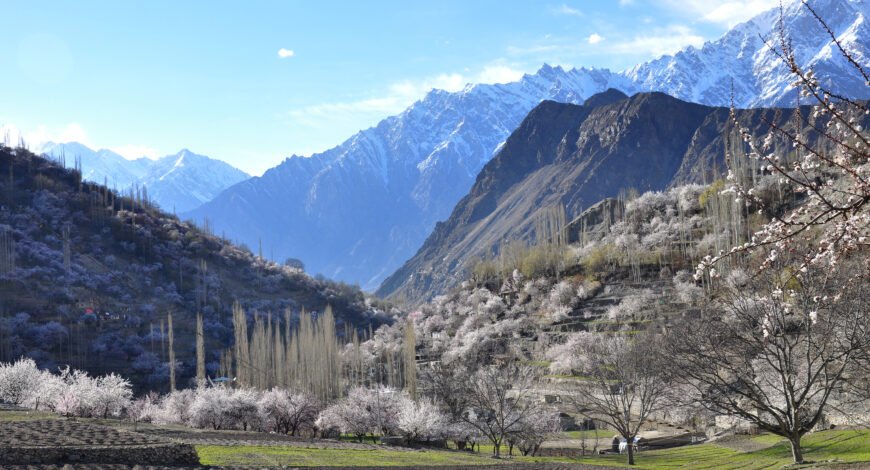
Ask why the apricots, sea buckthorn, buckwheat, and nuts of Gilgit-Baltistan taste so distinctive, and the answer is the land itself. Tucked between the Karakoram, Himalaya, and Hindu Kush, this is one of the most extraordinary growing regions on earth. Here is why it produces some of the world’s finest organic superfoods.
- High altitude, intense sun, and wide day-night temperature swings concentrate flavour and nutrients.
- Crops are irrigated with pure glacial meltwater.
- Farming is traditionally low-input — often organic by heritage, not just by label.
- The people and their know-how are as important as the place.
A growing region like nowhere else
Gilgit-Baltistan sits where three of the world’s great mountain ranges meet. Orchards and fields cling to valley floors and terraces above 2,000 metres. The short, bright summers and cold nights stress plants in a productive way: they respond by concentrating sugars, antioxidants, and aroma. That is why a Hunza apricot or a Skardu sea buckthorn berry tastes so much more intense than its lowland cousin.
Glacial water and clean air
Irrigation here comes straight from glacier melt, channelled through centuries-old water systems. Combined with thin, clean mountain air and distance from heavy industry, this gives the produce an unusually pure growing environment.
Organic by heritage
Long before “organic” was a marketing word, mountain farmers grew food with little or no synthetic input — because that was the way, and because the isolation made chemicals impractical. Much of the region’s farming remains low-spray and traditional, which is part of why its apricots, nuts, and berries are so sought-after.
The superfoods of the mountains
The region’s basket is remarkable in its range:
- Sea buckthorn — the vitamin-C-rich orange berry; see sea buckthorn benefits and shop dried berries.
- Apricots — including the prized Khalman variety; read Hunza & Khalman apricots and shop dried apricots.
- Buckwheat — naturally gluten-free; see our baking guide and shop buckwheat flour.
- Nuts — thin-shelled Kaghzi almonds and walnuts; see almond export.
- Salajeet — the mountain mineral resin; see our salajeet guide.
- Mountain honey — from local wild flora; shop mountain honey.
The people behind the produce
None of this works without the families who tend the orchards and dry the fruit on their rooftops. Since 2002, Pak Seabuckthorn International has sourced directly from these communities — keeping the supply chain short, traceable, and fair, so the people who grow the food share in its success.
Frequently asked questions
What makes Gilgit-Baltistan produce “organic”?
Much of the region’s farming has always used little or no synthetic pesticide or fertiliser. This heritage of low-input cultivation, plus clean glacial water and air, is why the produce is so often naturally organic.
Why does mountain fruit taste more intense?
High altitude, strong sunlight, and large day-night temperature swings push plants to concentrate sugars, antioxidants, and aroma compounds — giving more flavour per bite.
What superfoods come from Gilgit-Baltistan?
Sea buckthorn, apricots (including Khalman), buckwheat, almonds, walnuts, salajeet (shilajit), mountain honey, and a range of herbs and berries.
How do you ensure authenticity?
We source directly from mountain farming communities, keeping the chain short and traceable from orchard to pack.
Sources & references
- Pak Seabuckthorn International — sourcing in Gilgit-Baltistan since 2002.


